Part 2: The Aldi Operating System — Fewer Choices, Lower Costs, Better Experience
The entire store is designed like an engineer got to build a grocery chain from scratch with one goal: remove waste. Not just waste in theory, but waste in time, steps, labor, and complexity.
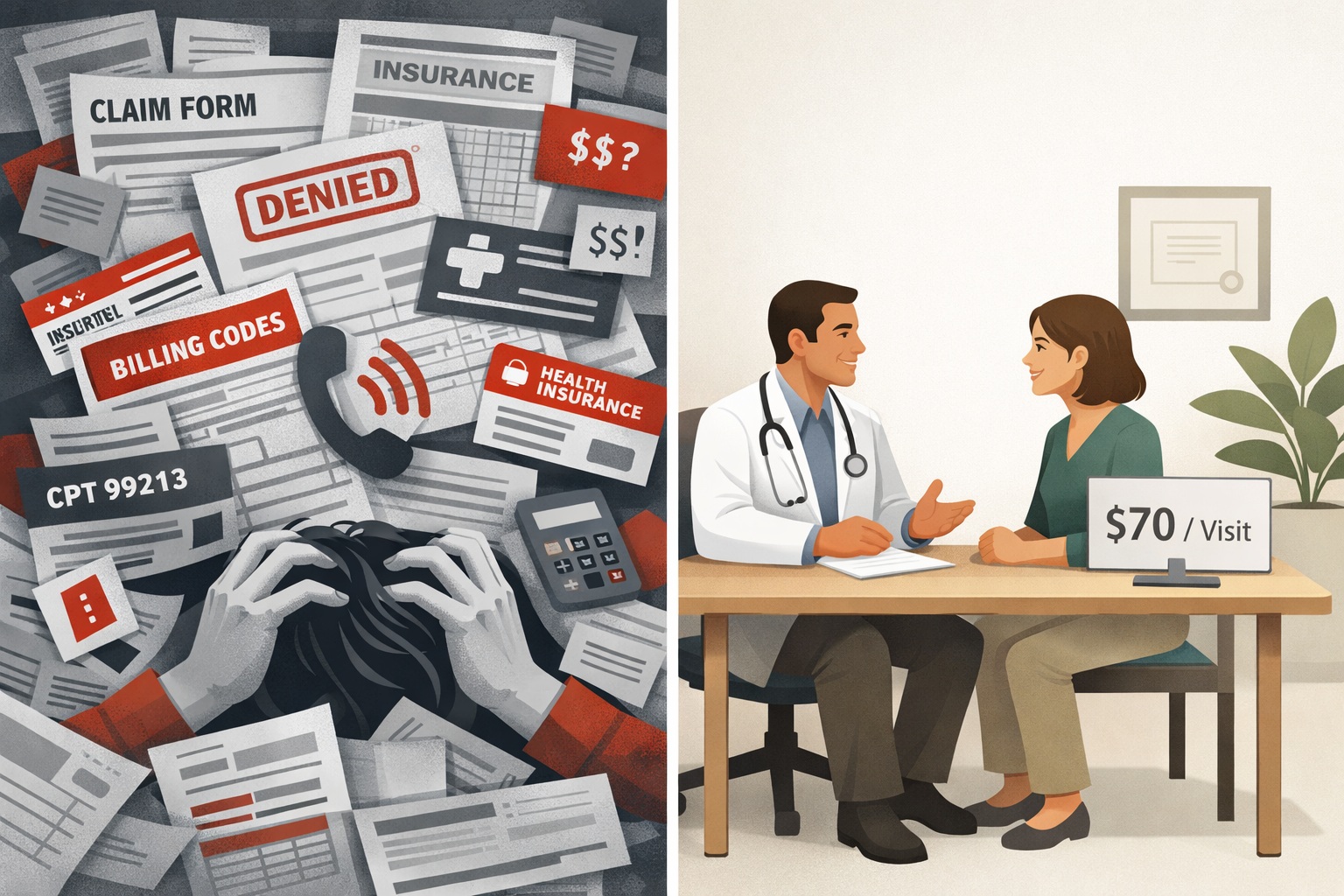
And that’s where DPC has a huge opportunity—because the biggest cost in American health care isn’t a pill or a lab test.
It’s the administrative machine built around billing, coding, contracting, and arguing.
Fewer choices is a superpower
Aldi limits selection on purpose. Fewer items means:
- less inventory complexity
- simpler supplier relationships
- faster stocking
- fewer moving parts
- lower overhead
The customer doesn’t get 40 kinds of ketchup. They get one or two, and they move on with their life.
Direct care can do the same thing, and many successful practices already do—whether they call it that or not.
Not by offering “less care,” but by offering a clean, tight bundle that covers most real-world needs:
- access (same/next day)
- continuity (a relationship with a clinician who knows you)
- simple communication (text / portal / async)
- transparent pricing
- wholesale meds and labs
- straightforward referrals when needed
When you define the bundle well, you reduce chaos for patients and for staff. And you remove the kind of ambiguity that creates frustration (“Is this covered?” “What will this cost?” “Why did I get this bill?”).
Design for speed (and the patient will feel it)
Aldi famously leaves products in their shipping boxes. That’s not laziness. It’s speed. The goal is to reduce time-to-shelf and minimize labor.
Health care has a thousand “little boxes” too:
- repeated forms
- repeated histories
- repeated logins
- repeated phone calls
- repeated insurance verification
- repeated “we’ll call you back” loops
A DPC clinic doesn’t need to copy retail gimmicks. But it can steal the principle:
everything should be designed for fewer steps.
Examples that patients actually notice:
- “Book online in 30 seconds.”
- “Text us; we answer fast.”
- “Here’s the price before you decide.”
- “Your labs cost $X; if that changes, we tell you first.”
- “We’ll coordinate the referral, not just hand you a phone number.”
This is where experience is born. Not from slogans.
Transparency isn’t marketing—it’s infrastructure
Aldi’s prices are the point. DPC’s pricing should be the point too.
Transparency is not a brochure claim. It’s a system:
- posted fees (or a clear “included vs not included”)
- predictable processes
- consistent language
- no “gotchas”
- easy ways to pay and understand
When transparency is baked into operations, it becomes emotionally calming. People relax when they can predict what happens next.
A caution: don’t turn “efficiency” into “sloppiness”
Aldi sometimes gets messy. Health care can’t. The goal isn’t bare minimum; it’s no waste.
DPC should aim for “quiet excellence”:
- fast response, but accurate
- simple workflow, but thorough
- fewer steps, but safer
- clear boundaries, but warm delivery
Efficiency isn’t cutting corners. Efficiency is removing nonsense so clinicians can do more of what matters.
The DPC version of “limited assortment”
If a practice wants to scale without breaking, it should be able to answer:
- What do we do exceptionally well?
- What do we not do?
- What’s our default workflow for common problems?
- How do we handle after-hours expectations?
- What’s our “this is included” list and our “this is extra” list?
- How do we keep access reliable as we grow?
When those answers are clean, the clinic becomes easier to operate—and easier to recommend.
The takeaway
Aldi proves that the best consumer experience isn’t always the fanciest.
It’s the one designed to be simple, predictable, and efficient.
Direct care’s advantage is the same: remove the administrative sludge, restore clarity, and make the experience feel normal again.
Next up (Part 3): how Aldi turns customers into a community—and how DPC can build a “cult of clarity” without being weird about it.